
Adv. Anubhav
The Bharatiya Nyaya Sanhita, 2023 (BNS) is India’s new criminal law that replaced the Indian Penal Code, 1860. It came into force mainly from 1 July 2024. the BNS introduced community service as a form of punishment. For the first time, Indian criminal law clearly recognises community service as one of the punishments under Section 4 of the BNS. This is a crucial step towards welfare because it highlights a shift from only punishing offenders to also reforming them,bringing positive behaviour and helping them return to society in a better way.
Community service defines that a convicted person is ordered by the court to perform some useful work for society voluntarily . The Bharatiya Nagarik Suraksha Sanhita, 2023 (BNSS) elaborates that community service is work ordered by the court as punishment, which benefits the community, and for which the convict does not receive any remuneration.
Meaning of Community Service
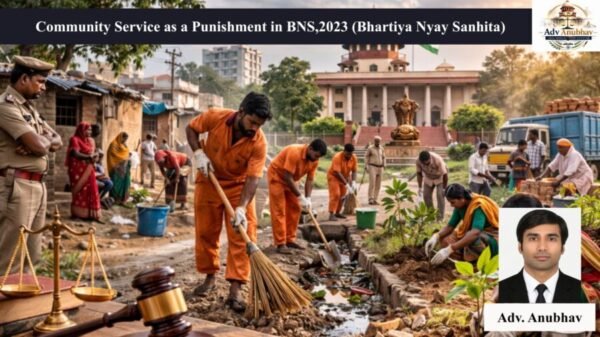
In simple words, community service is a punishment where the offender does not go to jail but performs work for the benefit of society on a voluntary basis . The punishment may include work such as cleaning public places, helping in hospitals, assisting NGOs, working in old-age homes, planting trees, helping in public awareness campaigns, or doing other socially useful work. The main intention is to make the offender understand responsibility and repay society in a positive way.
Community service is different from imprisonment. In imprisonment, the offender is kept inside jail and is separated from society. In community service, the offender remains connected with society but has to give time and labour for public good. This helps the person realise the effect of their wrong act and gives them a chance to improve.
Community Service Under Section 4 of BNS
Section 4 of the BNS lists the kinds of punishments that may be awarded for offences. These include death, imprisonment for life, imprisonment, forfeiture of property, fine, and community service. The inclusion of community service is new and important because earlier the Indian Penal Code did not contain community service as a regular statutory punishment for adult offenders.
The BNS has introduced community service mainly for certain minor offences. It is not meant for serious crimes like murder, rape, terrorism, or organised crime. It is generally used where imprisonment may be too harsh and where the offender can be corrected through a lighter but meaningful punishment.
Offences Where Community Service May Apply
Community service under the BNS is available for selected offences. These include: in conditions where public servant unlawfully engaging in trade under Section 202; non-appearance in response to a proclamation under Section 209; attempt to commit suicide to compel or restrain lawful power under Section 226; petty theft under the proviso to Section 303(2), where the stolen property is worth less than ₹5,000, the offender is a first-time convict, and the stolen property is returned or restored successfully; misconduct /misbehave in public by a drunken person under Section 355; and defamation under Section 356(2).
These offences are generally less serious compared to violent crimes. By allowing community service in such cases, the law gives courts flexibility. Instead of sending every offender to jail, the court can choose a punishment that is more suitable to the offence and the offender.
Objective of Community Service
The main objective of community service is reform. Criminal law does not only aim to punish; it also aims to correct behaviour. Many offenders, especially first-time offenders or those involved in minor offences, may not need jail. Sending such people to prison may expose them to hardened criminals and may harm their family, education, employment, and social life. Community service gives them a chance to learn from their mistake while still contributing to society.
Another objective is accountability. When an offender performs work for the community, they understand that their act has consequences. The punishment is not merely symbolic. It requires time, effort, discipline, and public responsibility. This can develop a sense of social duty in the offender.
Community service also supports restorative justice. Restorative justice focuses on repairing harm rather than only giving pain to the offender. It tries to restore balance between the offender, victim, and society. Community service may not directly compensate the victim in every case, but it helps the offender give something positive back to society.
Benefits of Community Service
One major benefit of community service is that it reduces the burden on prisons. Indian prisons are often overcrowded, and many people in jail are undertrials or persons involved in less serious offences. If suitable offenders are given community service instead of imprisonment, jail space can be used for serious offenders. The government has also recognised prison overcrowding as an issue in the context of new criminal laws and related reforms.
A second benefit is rehabilitation. Community service allows the offender to remain with family, continue work or education, and avoid the harmful effects of prison life. At the same time, the offender must complete a court-ordered duty. This balance can help in preventing future crime.
A third benefit is that society receives useful services. If properly managed, community service can help in cleanliness drives, environmental protection, public health support, traffic awareness, social welfare work, and assistance to local bodies or NGOs. This makes punishment productive rather than purely negative.
A fourth benefit is proportionality. The idea of proportionality means that punishment should match the seriousness of the offence. For a minor offence, imprisonment may sometimes be excessive. Community service provides a middle path between doing nothing and sending a person to jail.
Role of Courts
The court plays an important role in deciding whether community service should be imposed. The judge is required look at the nature of the offence, the background of the offender, whether the offender is a first-time offender, whether there was violence, whether the offender has shown remorse, and whether community service will be effective in that case or not.
The BNSS also recognises the power of Magistrates to award community service. A Magistrate of the first class and a Magistrate of the second class may pass a sentence of community service within their sentencing powers. This shows that community service is not only a theory but part of the criminal procedure system.
Challenges in Implementation of Community Service as a Punishment in BNS,2023
Even though community service is a positive reform, there are some practical challenges. The first challenge is lack of clear guidelines. The law gives the concept, but detailed rules are needed on the number of hours, type of work, supervision, reporting, and consequences if the offender does not complete the work. Without proper guidelines, different courts may apply community service differently.
The second challenge is supervision. If a person is ordered to do community service, someone must monitor whether the work is actually done. This may require coordination between courts, probation officers, police, local bodies, NGOs, and government departments. Without supervision, community service may become only a paper punishment.
The third challenge is fairness. Community service should not become humiliating or discriminatory. The work assigned should be meaningful and should respect human dignity. It should not be used to publicly shame the offender. The aim should be reform, not humiliation.
The fourth challenge is public perception. Some people may think that community service is too lenient. However, if it is properly structured, it can be a serious punishment because it requires discipline, time, and public responsibility. The success of this punishment depends on how seriously it is implemented.
Suggestions for Better Use
To make community service effective, India needs proper rules and administrative support. Courts should specify the exact nature of work, number of hours, place of work, reporting authority, and time limit for completion. There should also be a record of attendance and performance.
The government may prepare a list of approved institutions where offenders can perform community service. These may include municipal bodies, hospitals, schools, shelters, old-age homes, public libraries, environmental groups, and recognised NGOs. This will make implementation easier and safer.
Training is also important. Judges, prosecutors, police officers, probation officers, and local authorities should understand the purpose of community service. The government has already taken steps for training stakeholders in the new criminal laws, and such training should also cover community service in detail.
There should also be consequences if the offender fails to complete community service without proper reason. At the same time, courts should be flexible in genuine cases, such as illness or disability. The work assigned should match the offender’s age, health, skill, and circumstances.
Conclusion
Community service as a punishment under the BNS is a progressive step in Indian criminal law. It reflects that justice is not merely about harsh punishment but also about responsibility, reform, social healing and social transformation. For minor offences and suitable offenders, community service can be more useful than imprisonment. It can support the reduction of prison overcrowding, help offenders reform internally, and benefit society at the same time.
However, the success of community service depends on proper enforcement of the provisions. Clear guidelines, good supervision, trained officials, and just application are significant. If implemented carefully, community service can become an important tool of reformative and restorative justice in India. It can become a pillar to create a criminal justice system that is firm, fair, humane, and socially useful.
About the Contributor:
Adv. Anubhav (LLM,LLB,BBA and MA Economics)
Disclaimer: This article is intended for academic and informational purposes only. The views expressed are those of the author and do not necessarily reflect the views of any government institution.
References
Bharatiya Nagarik Suraksha Sanhita, 2023, No. 46, Acts of Parliament, 2023. Ministry of Home Affairs, Government of India. https://www.mha.gov.in/sites/default/files/2024-04/250884_2_english_01042024.pdf
Bharatiya Nyaya Sanhita, 2023, No. 45, Acts of Parliament, 2023. India Code. https://www.indiacode.nic.in/bitstream/123456789/20062/1/a202345.pdf
Drishti Judiciary. (2024, July 10). Community service under BNS. https://www.drishtijudiciary.com/to-the-point/bharatiya-nyaya-sanhita-&-indian-penal-code/community-service-under-bns
Press Information Bureau. (2024, July 30). Highlights of new criminal laws. Government of India. https://pib.gov.in/PressReleasePage.aspx?PRID=2039055
Rashid, I., & Pandey, A. (2025, January 27). Community service under the BNS: Progress, pitfalls, and potential. NLIU Law Review. https://nliulawreview.nliu.ac.in/blog/community-service-under-the-bns-progress-pitfalls-and-potential/